Blog

  • Some mornings, a coffee barista reminds you of a lost love

    Some mornings, a coffee barista reminds you of a lost love

    I was, if I recall
    Then, mechanistically unromantic
    A clockwork creature
    Desperately hungry

    The world was so new,

    And though I had never been
    The city was bigger than I remembered,
    The gravity of 23+9,
    Much as I explored it
    Explored me

    I haven’t been to Pakistan
    But I recall its subtle poetry in you
    High points on cheeks
    Of drunken escapades,
    Knowing glances
    Exchanged over office sandwiches
    The world’s most interesting playground
    Can appear
    In the most curious of places

    Toronto is not yours
    Nor is it mine,
    We were indeed
    Two extraterrestrials
    Serendipitous on a foreign planet
    Learning metropolitan camouflage
    Sharing winks
    At its various absurdities…

    Playing aloof,
    I replied
    “Even permanent marker washes off”
    When you said 
    I had left a mark on you,

    But how difficult it is to predict
    How a sapling
    Will grow and age
    In your grey matter,
    A new passenger
    Hitched along for the ride

    Someone old 
    You can pick out
    In unsuspecting faces.

  • A Heap Sort,

    A Heap Sort,

    A still life that refuses to stay still.

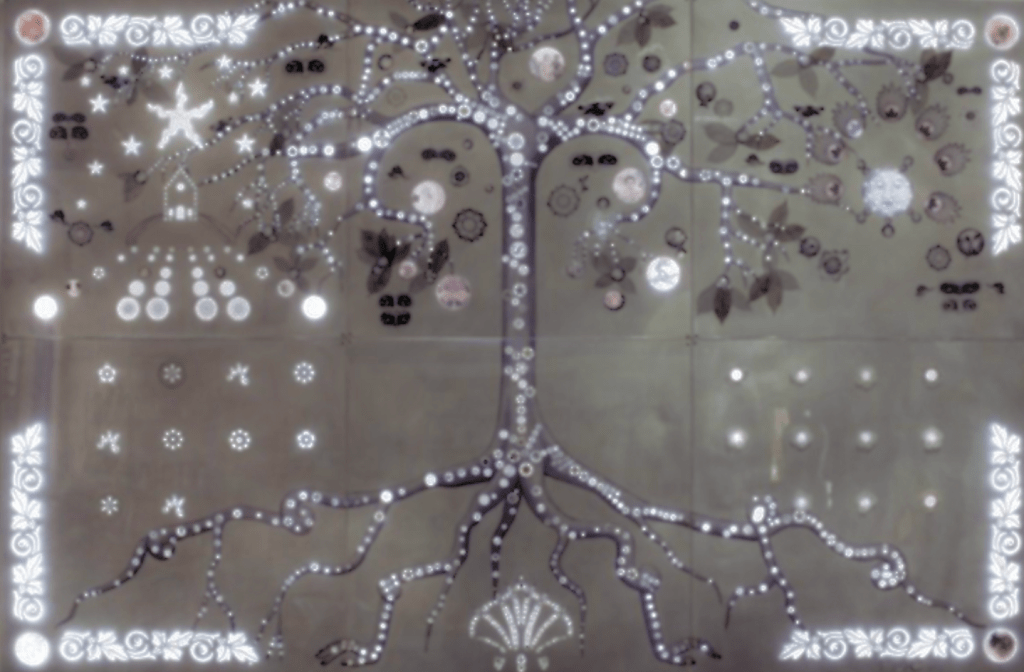
    Sugar and brine touch tongues that shouldn’t meet. Ink stains the water while something bright flashes once and is gone. What’s gathered from the ground is braided, then fed back to fire, which remembers everything. Cloth keeps the gesture of a hand; concrete keeps the gesture of winter. A heart opens and leaks without apology.

    A wing holds light the way a screen holds itself—looped, recursive, and with slight delay. Letters appear in a font that pretends neutrality while smuggling intent; a ± that never decides whether it’s healing or harm. The image watches the image watching the image.

    Caffeine hums like a low prayer to velocity. Fish gleam like punctuation. Dust settles on paper, insisting on time.

    It’s an altar, maybe. Or a debug log. Or a spell assembled from whatever was closest when attention struck.

  • On Soul Weights

    On Soul Weights

    In the platonic space of essences, there is room for everything. To think about all that could ever be, I find it useful—if obviously imperfect—to imagine a very high-dimensional vector space of vibes, ideas, and concepts. One element of this space could be “apple,” another “green,” another “rotten.” Much of what follows is intentionally simplified and not meant as strict mathematics.

    Imagine a human being as something of a multilayered neural network. (A groundbreaking analogy, I know.) Let’s take a vector from this platonic space—say, one encoding “taking a bite out of a rotten green apple.” To see how a particular human would react to actually experiencing (or even just imagining) this, we can perform a forward pass through their network; that is, feed that input vector through successive layers, allowing the information to flow and change as it progresses. At each layer, the inputs are multiplied by that person’s unique weights and passed through activation functions, until we eventually arrive at an output: a reaction vector encoding their emotional, physical, and behavioural response.

    Viewed this way, a human being at a singular point in time is defined by the full collection of these weights—their unique configuration of persuasions, their entire weight matrix. Thus, given different matrices for different people, input A may lead to response B for person C because of weights D, E, and F, but leads to response G for person H because their D, E, and F have different values.

    So let’s try to understand why a human ever reacts the way they do, and where these weights come from.

    Many of the weights fall into what I’ll call the nurture category. These are the tunable parameters in our brains—pliable clay we’re born with so that we can continue to adapt to our environment. For these nurture weights, repetition, habit forming, and feedback loops can increase or decrease preferences and aversions. With patience and consistency, it’s relatively easy to nudge these weights up or down to change outcomes.

    Then there are weights—or clusters of weights—that tend to be relatively fixed, at least from a certain age onwards. I’ll call these nature weights. Some of them are easy to explain through straightforward cause and effect. Hunger reliably makes food evoke a positive response. Fear, being so useful for survival, reliably makes predators evoke a negative one. These weights live in the body, you were born with them, and trying to change them usually doesn’t make much sense because they’re trying to keep you alive. Nature weights also encode one’s physical attributes—like height—which influence how we navigate the world. Plenty of creatures make nearly all their decisions based on these deeply ingrained mappings from inputs to outputs.

    But humans seem to have an additional set of unchangeable “nature” pulls layered on top of these biological, instinctual ones—pulls that don’t reduce cleanly to survival or comfort. This extra component encoded in our weights is what people often refer to as the soul: an idiosyncratic, unchosen essence that meaningfully shapes how a person responds to the world.

    What I want to propose is that this “soul” smattering constitutes a portion of the unchangeable nature weights within our overall weight structure, existing alongside—and interacting with—unchangeable bodily weights and changeable nurture weights. The totality of these weights, applied over time to a stream of inputs from reality (with each output influencing future inputs), produces the trajectory of a person across a lifetime.


    I’ve read books about past lives and the space between lives, often accessed through hypnosis. I’m not especially interested in litigating whether those accounts contain literal truth. What sticks with me is the recurring structure: a soul is paired with a body, the soul forgets itself, and then spends a lifetime trying to remember. Whether metaphorical or not, that understanding has persisted for a reason.

    It often feels as though the soul is constantly calling out to itself in the world. It wants to recognize itself and to be surrounded by the things that make those particular connections in the network sing. That’s why affinities can feel disproportionate to their apparent utility. Yes, strawberries and apples both matter to me for calories. I don’t even think I prefer the taste of one over the other. But strawberries feel like me in a way apples do not. Only one triggers the internal “!” of recognition rather than the indifferent “.” My soul—those unchanging emergent weights that don’t seem grounded in rational necessity—has contributed something extra to the concept of “strawberry,” amplifying my response far beyond bodily need. I don’t even need to think about eating a strawberry; I’m simply glad they exist.

    It’s worth saying that the boundary between nature and nurture is rarely clean. I’m not suggesting that my affinity for strawberries emerged fully formed, untouched by upbringing or chance. Of course it was shaped by countless small experiences—availability, repetition, context, memory. But what feels undeniable to me now is that, through the process of living and paying attention, something stable has emerged: a persistent self-identification with strawberries as a concept that (1) I don’t think I could do anything about if I tried, and (2) itself seems terribly happy that I know about it.

    The “goal” of the soul, if I’m allowed to speak teleologically for a moment, seems to be at least partially self-recognition. Those seemingly frivolous extra units of importance feel desperate to be noticed in a way other kinds of weights are not. There is something about the very existence of these parts of your weight structure that sparkles. Hot pink produces a “!” for me in a way canary yellow does not. Surrounding myself with hot pink doesn’t just feel decorative; it feels aligning. And noticing that “!”—recognizing that here, my soul sees itself—feels almost like the whole point.

    This is partly why exploratory mirroring matters. Sitting in the presence of different people, ideas, aesthetics, and sensations, and watching for the “!” allows you to discover parts of your weights that are undeniably you, even if they don’t make much sense.

    This might seem wholly self-interested, but it also has clear social and evolutionary advantages. Because the bulk of people’s nature weights are distributed differently across individuals (and are honed by circumstance), different people are suited to different environments. They thrive in different jobs, different relationships, different ways of living. This diversity is not a flaw; it’s the reason a complex social system can function at all.

    An accurate self-concept helps you find environments where effort feels sustainable and life feels coherent. Without that sparkly pull toward self-knowledge—toward understanding your oddly scattered preferences—self-actualization would seldomly happen. And without these strange, self-interested soul perturbations across the population, we wouldn’t have the diversity necessary for our thriving, resilient, chaotic, interesting mess of human creatures.

    So if that’s the case, then the job of being alive is something like this: update your weights—at least the nurture weights you can change—through experience, expression, exploration, and feedback loops, in such a way that two things happen.

    First, the parts of your weight structure that want to know themselves actually get the chance to. Since we’re all self-obsessed little creatures, this process is luckily pleasurable and self-motivating once it gets going, even when it leads through discomfort. As you get to know your nature, continue updating your changeable weights in ways that honour the weird preferences and aversions that are your birthright. Unmasking these parts of ourselves is what our inner-guidance systems are always trying to move us toward.

    Second, once you have a clearer sense of what lights you up—what floats your boat, stirs your coffee, fills your cup—follow that scent out into the world. Once you recognize the “!” of a soul connection, you can begin to sense it behind closed doors and amid uncertainty. By following your “!”, by scraping up against your own peak experiences, and by taking risks on behalf of what your unchangeable weights are trying to communicate, you’ll find that there really are pockets of this world built for people with a soul configuration just like yours.

  • An Ode to the Snowfeeder

    An Ode to the Snowfeeder

    The streets in front of my house are underwater
    Approximating deepest winters’ depth;
    What feels like a cruelly cold expanse
    Below sea level pressures
    Entropy slows still, among other things
    And in the darkness,
    Strange creatures move in

    I know you’re not interested in me
    But I wonder
    Were we face to face,
    What might you tell me?
    What have you seen?

    Your evolution’s intention speaks poignantly
    Primordial oils power your nervous system,
    Crustaceans born immortal to lumber with
    luminous, stalked, bio-mechanical eyes,
    Urban filter-feeders fully foreordained 

    I’m only a small fish,
    But as we pass each other in the night
    In your enduring preoccupation,
    My structures sing out to you.

  • Hope? No. Is it fear?

    Hope? No. Is it fear?

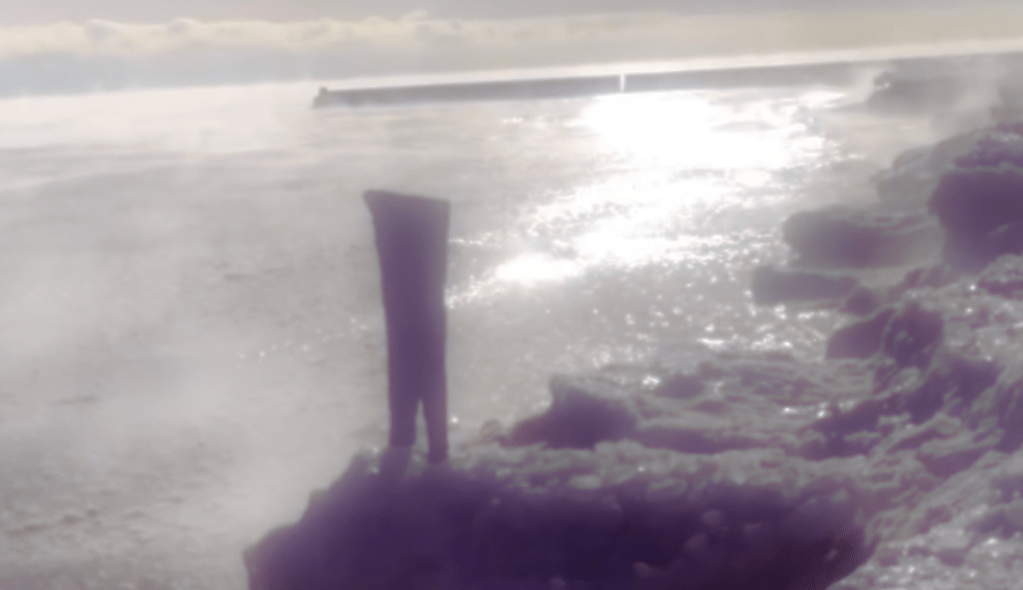
    The winter water forms a dulcet froth as it churns bubbles and ice and air.

    The winter sun is setting. Or rising. Skims of golden hour sunlight make their way through the water as the waves crest, whose murky character returns as they are pulled back into the depths. The lapping waves are dense with chunks of ice, tossing them about like buoyant pebbles, smoothing them to seaglass. 

    Larger waves toss the tumulted sea ice onto the frozen banks, where you can stand to watch the waves with relative safety; the largest piece could squarely cover the palm of your hand. Brushing against their melting point, the airy-icy cobblestones, covering every surface, glisten diffusely. The stones glide easily among and across each other, scattering at the slightest disturbance. Frictionless, cold, and slowly forgetting the churn of Lake Michigan they just endured as they bake out in the frigid air.

    The frozen bank is craggy, jutting in and out, ceaselessly bracing against the churn of the water, losing and gaining parts of itself with every wind-swept watery advance. As waves crash, clouds of glittering mist are drawn up from the depths, catching every ray from the drooping sun. The air hangs cold and heavy, bearing down indifferently on the activity of the water, a highly-contested battle between stillness and noise.

    In front of you, cresting a small mound of icy bank: standing tall, a frozen, defiant pair of skinny-fit denim blue jeans. 

  • Liturgy of the Sink Demon

    Liturgy of the Sink Demon

    My childhood home has been haunted since before I can remember. Not the kind of haunted that causes strange noises in the attic, and only sometimes the kind of haunted where the lights flicker conspicuously during arguments. 

    No, the entities that live here are agents of imbalance, self-sustaining in their madness; like a pot you can’t take off the stove that’s always threatening to boil over. An imp that has grabbed hold of something precious and has taken off running in a direction you didn’t quite catch. Seeds of chaos in the pipes entombed by a family’s survival through nearly three decades of both miracles and miasma. Clinging disorder that shrouds itself in layers of psychic fog, an embodied torpor that uses the brain’s natural circuitry against itself. 

    The very best example of this is the demon that lives in the kitchen sink. 

    From my childhood and adolescence, I recall memories of dishes piled high, sometimes days-old, threatening to collapse under the weight of white ceramic bowls, peanut butter knives, and lids that don’t quite fit anything. Bloated grains of rice and remnants of salsa jars and paper labels from cans would combine into a heterogenous slime near the drain, threatening psychic damage to anybody who dared disturb it. Newly washed dishes often mingled with dry ones on the rack. Chaos would grow from that plumbing, again and again, no matter how many times my mother fought it back down to the shiny stainless steel surface. 

    The demon did a great job sustaining itself on a household already destined to suffer from chronic stress—stress made extra spicy with a good helping of neurodivergence and disability. It fed off of the shame and indignance felt by the kids after continual naggings from Mama Bear, and the frustration of Mama Bear that her cubs only ever seemed to nurse more chaos than they could dispel, not yet mature enough to recognize her efforts. I know all too well as an adult that helpless situations beget depression, and depression saps energy; energy that could be put towards real, sustainable progress against the forces of evil.

    When we did buy a dishwasher, the demon made sure it was one that siphoned water from the sink’s faucet for the entire three hour cycle, leaving no room for washing or rinsing in the meantime. Attempts to help always somehow further entrenched the problem. What are you supposed to do with horrors that feed in the space between your physical surroundings and your subconscious?


    I’m grown now. Fledged. I left the nest no less than five years ago; I’ve made multiple households and communed (consciously and unconsciously) with many demons of my own in the meantime. I’m housesitting for my parents right now, and while the sink is quieter than it used to be, and many stresses have been lifted from this dysfunctionally functional family, I can tell this spirit is still working on me and my loved ones. What is it, truly, that the dregs of this sink demon wants from us, even after all these years? 

    As already wisely noted by the outstanding poltergeist whisperers of our time, the answer to any demon problem is acknowledgement; simple acknowledgement. Yes, there is a demon in my sink. Yes, it is doing everything in its power to keep us all merely surviving under a mountain of undone-ness. Yes, it demands tribute, daily, in the form of small tokens of recognition. To manage, I’ll honour it every so often with a simple verbal nod, paired with a small but meaningful decision, such as putting my plate in the dishwasher rather than the sink’s basin, or emptying the drain catch when I don’t have to. Yes, if I ignore the demon’s creeping tendrils, it will become irate, offended that I have no respect for its wretched potential. 

    No, I cannot destroy the demon; yes, I know it will always be there. This being said, yes, a moment of true, conscious recognition of its demon nature—the bravery to look a real evil in the eye, followed by consistent (even if imperfect) observation and reverence—can soften the miry grip of any malignant spirit.

  • On the Impossible Task of Completion

    On the Impossible Task of Completion

    The Puzzle

    I have a vision of myself in my mind’s eye: I’m sitting in vastness, alone. I’m neither inside nor outside—above me is a slightly off-white overcast fog, and below me is a floor made of textured grey rubber that stretches endlessly in all directions. I’m surrounded by puzzle pieces; piles and piles of them. Some of these piles are sorted. Most sit in large, chaotic mounds that seem to grow bigger every time I turn my back. Between them, stray pieces are scattered with semi-intentional fervour. And here and there, in quiet little clusters, are the patches I’ve managed to piece together.

    The work of soul-making is (1) endless, (2) full of what many would call drudgery, and (3) brutally murky. Still, all of us have been given the same strange task: to gather the scattered parts of ourselves, try to understand them, and somehow make them belong to each other.

    Now and then, as you sort, beholding edge upon edge, something clicks. A few pieces fall into place and form a shape that makes sense, if only for a moment. Those moments of grasping even a small fraction of the final image can feel like small miracles—tiny confirmations that your effort matters. And sometimes, more rarely, you glance up and realize that two distant islands of pieces you’ve been working on separately for years actually belong to the same part of the picture. Their edges align, and suddenly, you can see something broader, more coherent than you could before. A glimpse of the larger shape your life might be making.

    Puzzle pieces pile up faster than you can work through them. Beyond the sheer number, there are the small indignities of handling them—some pieces are waterlogged from the occasional storm, some are frayed at the edges from being turned over too many times. A few have gone missing entirely, carried off by the dog, misplaced in old memories, or buried under something you’re not ready to face. Sometimes, just grasping the scale of it all—how much there is to sort through, how little you actually know—feels so overwhelming you have to check out for a while. Still, the hope is that if we understand the pieces we’re working with, if we sit with them long enough, we can fit them into something whole. That each one has a rightful place in the larger picture of who we are.

    This has been the shape of most of my 26 years: patiently sorting, gently fitting, watching connections form and trusting that if I just keep going, eventually the full picture will reveal itself. That I’ll understand what I’ve been building. That I’ll finally know who and what I am, and that peace will follow.

    The Shadow and the Struggle

    Not all of us go looking for trouble, but all of us find it in one way or another. Your puzzle pieces aren’t just bits of personal insight—they’re everything you understand about the world and yourself. The way they’re laid out, the way they connect (or don’t), quietly shapes the choices you make and the paths you follow. Sometimes it’s conscious. Often it isn’t. And because of that, you can spend years living out patterns set in motion by something long forgotten. Pieces get buried even deeper. But then, something cracks. Something hurts just enough to make you pay attention. And suddenly you look down and realize you’re holding a piece you’ve never quite seen before. You wonder how long it’s been there, waiting.

    Shadow work is the process of turning toward the parts of yourself that have been buried—often out of fear, pain, or shame—and gently bringing them into the light. In other words: going digging for those puzzle pieces that allow you to fully comprehend parts of your puzzle’s picture that you unconsciously fear seeing, yet feel mysteriously incomplete without. The trouble is, most of those shadow pieces (is this Yu-Gi-Oh??) are buried in the same towering mounds as everything else—habits, old defenses, stories you inherited without even realizing it. They’re often hiding in the piles that are the most daunting to sort through, and you’re largely diving into the process without even knowing what you’re looking for.

    There’s something deeply exciting about watching these little islands of understanding come together—whether the pieces are joyful or painful, euphoric or hard to hold. There is a real sense of progress, and I truly do believe that my practice has given way to real, positive change and healing that would not have otherwise been possible.

    It’s tempting, however, to draw sweeping conclusions about the whole picture based on what you’ve managed to assemble so far. Our brains are wired for narrative, and when a few pieces start to click, the mind rushes in to fill the gaps. It spins stories between and atop fragments, weaving a sense of clarity that can feel real, even when it isn’t. All narratives, no matter how grounded they seem, are always incomplete. They’re shaped by ego, for better or for worse. They can distort as easily as they clarify. And in getting caught up in the imagined whole, we often miss what’s right in front of us—or twist it into something it was never meant to be. Maybe the hardest part of all, though, is that even as these little breakthroughs come, they’re quickly absorbed into the background. Another fleeting rush of purpose, swallowed by the hedonic treadmill. The moment fades, and the search for new “insights in a haystack” begins again.

    Putting It All Together

    I sat with my pieces a few times today, legs crossed on the rubber floor, drifting hazily between the real world and my cardboard mounds. I surveyed the piles and the scattered patches. Everything felt very still. I glanced at a small story of pieces forming in front of me: this one telling of the unease I was starting to feel with my seemingly never-ending puzzle journey. I thought about all the ups and downs since I started, and the truly staggering progress I’ve made with the raw materials I have been given. All the beauty and the pain I’ve been able to touch because of this practice. Then I looked again at my unsorted piles. They were larger than ever. And I realized—even if new pieces stopped arriving tomorrow—with the time I have left on this planet, it is certain that I’ll die before I can see my puzzle to completion.

    So… what do you do when this realization knocks? Not just as an abstract idea, but as an intuitive truth? How do you live with a puzzle that must, by design, be left unfinished?

    I’ve come up with three options. One: quietly tuck it away—put the whole thought back in its box and let this particular emerging patch of puzzle pieces fall to the wayside. Keep living under the belief that you’re working toward completeness, and that if you just keep going, if you just try hard enough, you’ll get there, and you’ll find peace. Two: give up on the process entirely. Let the pieces pile up as they will. Stop sitting upstairs in your brain like a nerd, wasting your energy trying to make meaning out of chaos. And then there’s the third option: keep assembling what you can, here and there, in fragments—and try not to care too much that you’ll never get to see the finished picture.

    I think I’m aiming for that third one. Most days.

    Whatever I manage to put together in this life, I suppose that’s as complete as it gets. Maybe, if I squint, that’s not a tragedy. We’re here not to finish our puzzles, but to piece together what we can of them. To leave behind small pockets of clarity; pretty little constellations of meaning. If I go out surrounded by unfinished edges, I hope at least some of it feels beautiful. Not complete, never meant to be, but real. Touched, and known. Maybe that’s all any of us can hope for in the end. Not a finished picture, but a life spent slowly learning how to sit with the pieces—and, ideally, an unshakable understanding that the work you have done is nothing more (and nothing less) than simply, enough.

  • The TV Show I Can’t Turn Off

    The TV Show I Can’t Turn Off

    Today has been a ride. A lurching, inconsistent, weirdly-edited ride. Many days over the past few months have been like this. Certainly more than average from my recent memory. I keep returning to the thought:

    “Sometimes, the TV show just sucks.” 

    There were years where I’d just zone out during the bad episodes—when the writing felt phoned in, when I didn’t care about the characters, when the pacing was off or the whole thing veered into absurd prisonous melodrama. I’d mentally leave the room, distract myself with psychic busywork, and concern myself (sometimes pathologically) with story beats that were more compelling than what was happening in front of me. Slowly though, I realized: tuning out the dreadful parts doesn’t actually make the show better. It just flattens everything. Even the good scenes lose their meaning when you’ve been numbing yourself.

    Mindfulness teaches us to be present; to feel the emotions your TV show, your life, evokes in you without judgement or pretense. This idea has changed my life, but what an immense burden it can feel like; a spiritual contractual obligation to sit through every single episode, knowing that no matter how horrible it feels, the alternative is worse. You have no remote. No skip button or fast-forward. The best you can do is sit there with your eyes propped open, clockwork orange-style, watching your life unfold. 

    Because, ultimately, this is the only show you get. There is no second channel. No spinoffs. You can choose this, or you can choose nothingness.

    We have understandably evolved to believe that we are controlling the plot of our TV show. Some people who prefer a bit of abstraction have touted the “life is just a video game” mantra – which allows for a certain level of emotional detachment from the destabilizing forces around you. But sometimes, in moments of stillness, you look around and realize that not only are you not this main character you so identify with—there is no controller in your hands. There never was. You’re not in charge. The real essence of “you”, what feels conscious, is just a watcher; akin to someone at the cinema getting so lost in a movie that the boundaries between them and the film’s universe dissolve. Or, maybe, you’re spacing out, not paying attention, living in your own thoughts. Or, perhaps, you’re sitting there, wishing things were different.

    If I have one thing for the complaints department, I wish that realizing you’re not steering makes the stakes feel lower. If anything, it just makes them weirder. “Oh great, I still have to feel everything, even if I can’t do anything about it?”

    And yet, even if you’re not the one making decisions for your main character—it’s not like nothing changes in life, or that things don’t get better. I don’t feel stuck in some cosmic rerun, doomed to repeat the same storylines. In fact, the main character of my show is really quite good at growing. She’s getting good at learning how to work with herself, reshape her environment, and sit quietly and peacefully. She spends an enormous amount of energy peeling layers back, tending to old wounds, tracing patterns back to their origins, learning sophistication in her feelings and practicing (and simply being) whole. That process makes for pretty compelling television, in its own funny way. The me watching all this unfold in a Google Doc is at least somewhat bemused by this fourth-wall-breaking emotional arc in particular.

    I’ve changed more in the past few years than I thought possible. I know myself now in ways I hadn’t since I was a kid. There is momentum, evolution, movement.

    But still—here I am. Sitting at my desk. Irritated with my texting apps. Raw from the fact that being emotionally open with the world has made me vulnerable to all sorts of bizarre new pain I didn’t want. Stuck on the treadmill, grateful to be moving, but also, sometimes, tired of running.

  • Love and Genetic Alchemy

    Love and Genetic Alchemy

    1

    Love doesn’t just touch you—it rewrites you.

    It gets under the armour, past the walls, slipping between the cracks of who you think you are and splicing new code into your being. Love has high penetrating power. It works its way in like a virus or a gene-editing enzyme, excising pieces of you and stitching something new in their places. Love has the targeted DNA shearing power of a CRISPR protein, and in the aftermath of the double-stranded snip, cellular repair squadrons swoop in to rewrite parts of your psyche with the borrowed strands of another’s genome. And once the new code is in, once the sequence has been altered, you are never quite the same again.

    I can see this in myself. It took me a long time to notice how much of me is a patchwork of people and things I have loved. How much I am a chimera, a genetic mosaic made from every connection that has ever mattered to me. New ways of thinking, new instincts, new affinities—traits that seemingly didn’t exist before, now woven into the fabric of who I am. Sometimes, the transformation is stark and undeniable. Other times, it’s subtle, a quiet shift in perspective that only reveals itself in long hindsight. 

    This is why love can be terrifying. It changes you, and not always in ways you expect.

    2

    There is a reason that heat is a catalyst for many chemical reactions involving DNA. Love doesn’t just change you—it warms you up, makes you malleable, softens the rigid structures inside of you. It moves through you like fire, like water, like something that has the power to undo all the careful ways you’ve held yourself together. There’s a reason why the most intense moments of love, grief, passion, or revelation feel like they shake you apart—because they do. Love pumps energy into you, heightens your emotional frequency, and suddenly, you are no longer solid. You are vibrating, melting, reforming. Some transformations happen slowly, like water carving stone over centuries, the edges smoothing so gradually you don’t even notice the change until you compare yourself to who you once were. Others happen in an instant, like an atom bomb detonating inside your chest, obliterating old structures before you can even understand what has happened.

    I like to think that we were all born as plasticine blobs, pre-shaped to an extent, but mostly undifferentiated. We begin as something soft, impressionable, capable of being molded. Our nature (genetics) sets the basic parameters—the hue, the density, the initial form of our sculpture. But it is experience, it is connection, it is love that presses into us, leaving imprints, reshaping us into something new. Some experiences leave small marks, barely perceptible indentations, while others press in so deeply that they change our entire shape. Over time, we become a mosaic of everything that has ever touched us. And it isn’t just love as we understand it that does this—it’s anything that moves us. Anything that stirs emotion, anything that heats you up, has the power to reconfigure you; love just does it best. It is the things you don’t care about that tend to leave you unchanged. 

    This is why resistance to love can feel like freezing—a rigid refusal to let yourself soften, to let warmth reach the places that have been locked in ice. The more frozen you are, the harder it is for love to get in. You convince yourself that you are protecting something essential, that staying solid, staying intact, is the safest thing to do. But the moment you allow yourself to feel, to be fully immersed in the present, to surrender to the current of transformation—you melt. And melting isn’t destruction. It is the return to something fluid, something adaptable, something capable of flowing into the spaces you were never able to reach before.

    There’s a theory that heightened emotion is the key to manifestation; that a clear vision accompanied by strong feelings is what opens the door to change. When love (or joy, bliss, gratitude, etc.) floods you with energy, it makes you plastic, pliable, open to new possibilities. It breaks down old bonds, dissolving rigid beliefs about who you are, allowing something new to take shape. This is why change so often feels like an unraveling—because it is. You are being taken apart so that you can be put back together in a way that better fits the person you are becoming.

    Maybe this is why love changes people so profoundly. Maybe this is why it feels like some force greater than yourself is at work when you fall deeply into it. It is not just affection. It is not just connection. It is a process of alchemical transformation. And if you let it in, if you surrender to it, if you allow it to warm you, shake you, melt you—you will become something new.

    3

    Love is supposed to change you. That’s its nature, and our nature. But what happens when you resist that change? What happens when you brace yourself against it, trying to hold your shape, refusing to let love reach inside you?

    There are so many reasons why someone might harden themselves against love. Maybe it’s the fear of losing control, the fear that if you let yourself be changed too much, you will no longer recognize who you are. Maybe it’s the belief that you must protect yourself, that being reshaped by someone else’s presence is a kind of invasion. Or maybe you’ve been burned before—maybe you’ve opened yourself in the past, let love carve into you, only to feel like you have been left with a worse version of yourself. And so, instead of letting love in, you fortify yourself against it. You put up walls. You tell yourself you will only love if you can control its effects, if you can keep yourself intact.

    But love doesn’t work like that. It doesn’t negotiate. It doesn’t ask permission before it starts rearranging you. And if you try to resist, if you brace against the impact, the result is not safety—it’s damage. It’s like trying to contain an explosion by tensing every muscle in your body, believing that if you just hold yourself together tightly enough, no one will see or feel the blast. But the force has to go somewhere. And instead of being absorbed, instead of integrating, instead of flowing through you naturally, the energy turns inward. 

    This is where love turns into suffering. Because resisting love doesn’t keep you from being reshaped—it fractures you like brittle ice. The parts of you that were meant to grow and expand instead become compressed, tangled, distorted. And eventually, when love is forced into such an unnatural shape, it curdles. It can become resentment, fear, even hatred.

    Hatred, in a strange way, is its own form of love. It is not cold. It is not indifferent. It is heightened emotion, and like all heightened emotions, it has the power to change you. This is why disdain and contempt are so dangerous in relationships. The moment you begin to look down on someone, to view them with a sense of superiority or judgment, your brain begins protecting you from them. It starts whittling down your capacity to feel love for them, because deep down, it knows that love begets openness, and openness means allowing yourself to be changed. If you are afraid of that change—if you overemphasize their flaws and convince yourself you would never want to be altered by them—you begin to love them less. One of my favourite quotes, which you likely will have heard if you know me in real life, is “the opposite of love is not hate, it’s indifference.” I know for a fact that I have loved and hated something strongly at the same time. I never loved or hated something at the same time as feeling indifferent towards it.

    Sometimes, that aforementioned “disdain” protection mechanism fails. Sometimes you love someone or something even when you believe you shouldn’t. Maybe it reinforces the most self-destructive parts of you. Maybe it brings out a version of yourself that you don’t want to be. Maybe you’ve convinced yourself that the love is wrong, that you must fight it, that you cannot let it touch you. And yet, despite everything, it still does. Love is not always gentle. Sometimes it is an earthquake. Sometimes it is a wildfire. And sometimes, it is a force you try to resist with everything in you, only to find that it has already reshaped you in ways you can’t undo.

    4

    How do you know that you’ve loved something? Not just liked it, not just appreciated it, but truly let it touch you, seep into you, change you?

    My simple proposal is this: if you are different after it, you have loved it. Love is transformation. It does not leave you as it found you. The things you have loved shape you, leave their fingerprints in your psyche, their colors in your soul. The things that have mattered to you are woven into your very being, sometimes in obvious ways, sometimes so subtly that you don’t even notice until years later, when you catch yourself doing something, saying something, believing something—and you realize, this wasn’t the same me as before.

    That’s how you know love was there. You are a mosaic of everything you’ve ever felt those heightened emotions about. A genetic chimera, a patchwork creature assembled from the fragments of people, ideas, moments that have left imprints on you. If you look closely enough, you can trace the lines, find the seams, see the places where the architecture of your identity has been altered. And the most profound changes are not always from the people you spent the most time with. Some shifts happen in an instant. Some influences cut so deep, they become part of you overnight. Others take longer, working their way in over time, settling into the crevices of your being until they are indistinguishable from the rest of you.

    But here’s the thing that’s always true—you have to be open to love’s influence.

    Because: resisting and struggling against it warps you. Love requires a kind of surrender, a willingness to let yourself be reshaped. When you fight against it, when you try to control the process, you don’t actually stop the transformation—you just make it more painful. Love will change you, whether you want it to or not. But how it changes you depends on your ability to allow, to receive, to flow with it rather than against it.

    I’m starting to understand what it means to be open to having love alchemize me. To allow it to move through me rather than trying to leash it. To trust that whatever it shifts in me was always meant to be uncovered, was always part of me, just waiting to be activated.

    I guess I’m a mosaic in the same way that the art I make is. A combination of different textures, different influences, different materials fused together into something uniquely mine. I am a multimedia piece—shaped by music I’ve listened to, books I’ve read, places I’ve been, people I’ve known, and the emotions I have let myself fully feel.

    Love gets into all your nooks and crannies, filling the spaces between the pieces of you, fusing them together in ways you never could have done alone. Its penetrating power is high—it seeps in like psilocybin, rewiring your brain, revealing new pathways, opening doors you didn’t even know existed. And once you’ve seen yourself through love’s lens, you can’t unsee it.

    If I had never loved the way I have, I know for a fact I would not be the person I am now. But trying to trace back the exact influences, to extract which exact pieces came from where, feels impossible. Maybe it doesn’t even matter. All I know is that if I want to keep growing, if I want to keep evolving into whoever I am meant to become, I have to keep seeking love. In people, in experiences, in the quiet moments of resonance that pull me toward something I don’t fully understand yet.

    Because love is a mirror. It reflects back the parts of you that you haven’t fully met yet. And when you let it in, when you surrender to the way it rearranges you, you become something new.

    Love has changed me deeply, and I hope love changes me 10,000 times over again.

  • Observation, Parenting, and Becoming Real

    Observation, Parenting, and Becoming Real

    There’s something magical about observation. In physics, the very act of observing a system forces it to collapse from a state of infinite possibilities into a single reality. This idea—so profound and strange—feels equally applicable to the inner workings of our minds. I am coming to understand that observation has power that can’t be overstated. It is only through observation that we can begin to understand the strange totality that is “us” or “me”; and only by understanding ourselves, or being understood, can we begin to truly exist.

    I’ve read many thinkpieces (and a modest handful of books), watched many YouTube videos, and attempted to comprehend many psycho-spiritual tools that seek different ways to fragment the self—to best break you down into pieces for the mind to understand. The ancient Greeks seemed to prefer the two opposing forces of heart versus mind (or, relatedly, the right versus left hemispheres of the brain), people will draw borders between many combinations of the Body, Heart, and Mind (or Flesh, Soul, and Spirit) from spiritual tradition, there is Freud’s Id, Ego, and Superego, the Social Self vs. True Self (Donald Winnicott), the forces of Yin and Yang, the Enneagram of Personality, and Jung’s Cognitive Functions. Many, many more of these theories exist. While I admit this may be a personal failing of mine, I have been having trouble tangibly applying these principles to arrive at a stable sense of self since I was a teenager.

    Recently, though, I think I have stumbled upon a delineation that my intuition can really bite into. I can divide myself neatly (mostly—I’ll get to this later) into two parts; the watchful, logical part of me that evaluates and guides, and the instinctive, emotional, and tangible part of me that simply acts. I’ve come to see these two parts as my “parent” and my “child.” The parent is my frontal cortex, the part of me that seeks to protect, to correct, and is concerned with logic, morality, and matters of right and wrong. The parent is conscious, and when I say “me”, that’s normally what I’m referring to. The child is everything else—my body, my subconscious mind, my autonomous nervous system, my feelings, my impulses, my learned behaviors, and my irrational loves and fears.

    For a long time, my inner parent (which I’ll henceforth use interchangeably with “me”) was a helicopter; classically overbearing and judgmental. I was always ready to step in and correct my child, to micromanage her every move. And while I thought this was the way to become “better,” (and I do admit, this was effective to a point) what I was really doing was stifling her, talking down to her, and insulting her intelligence and inherent beauty and goodness. I didn’t trust her, I didn’t really even like her all that much, and she knew it. Over time, she stopped expressing herself freely, or (often destructively) expressed herself only in the times and places where I was too preoccupied or checked-out to notice or care. I do not blame her for this. The innocence of a child, even the very fabric that makes up a child, is fragile; children can be hurt, and sometimes irreparably so. It is with great sorrow that I think back to the years where all my child saw from her caregiver was the reflection of the world’s judgment. 

    Recently (and slowly), after many years of grappling with trust and confidence in myself, I’ve started to parent differently. I’ve decided that in most situations, it is better to observe, rather than interfere. To cultivate a kind, watchful eye over myself—not to grasp desperately and control, but to guide gently, slowly, and iteratively, with many words of love and encouragement. I’ve learned to trust that my child knows what she’s doing most of the time (she is 26 now, after all), and that she needs freedom to explore, to play, and yes, to make mistakes. 

    This shift has been transformative for me. It feels as though my child can breathe for the first time in years, and the result has been astonishing. She’s witty without trying. She can be bold. She’s capable of handling situations that the parent brain used to think she couldn’t manage without its constant supervision. By giving her the freedom to be herself, I’ve discovered parts of me that I didn’t know existed—parts that are effortlessly strong, resilient, and joyful. I even recognize now that most of the words that come out of my mouth are not actually mine—they’re hers. It is also only through this process that I have been able to cultivate true belief in anything, because without the tangible experience of falling down, getting hurt, and getting back up again, everything that I thought may be true about myself, my true, child self, remained painfully untested. 

    I can’t shake a sense that no facet of a child is real until someone lays eyes on it. While I’m learning to be a better parent, and I can (and must) be the main person to guide her self-actualization, I am certainly not perfect. The idea-land of the parental frontal cortex is beholden to its inner logical model of the world, and blind spots in one person’s individual logical framework are unavoidable. Much like a child needs friends and playmates and a community for proper development, there just seem to be some people on this planet that can see my child, flaws and all, with more acuity and in darker places than I have ever been able to muster. While this process is not always pleasant, please, cherish and love the people who can see your child in the ways that you cannot, and trust and care for you enough to help fill in your gaps. 

    One night, recently, I could tell I was swimming in a veritable soup of emotions. I had just returned home after a few wonderful, yet charged days—days with stakes, where I was navigating complex feelings, grappling with my sense of right and wrong, and pouring energy into steering my ship gracefully. It was a constant, delicate, joint negotiation between my parent and child. During these days, we undeniably and demonstrably worked very well together. I was writing in my journal at my kitchen table trying to process everything, and suddenly, the earth seemed to split in front of me. I turned off my judgemental brain, opened my eyes and senses to what was about to happen, and watched. 

    Floodgates suddenly opened, accompanied by messy, heaving sobs and hiccups. I recall watching myself standing bent over a kitchen chair, crying into it like it was some kind of receptacle for years of pent up frustrations. I watched myself get up, pace around, lean back on the chair, reread what I had just written, shake my hands and body, and bawl some more. It was as though a panic-laden anger had erupted through me, the type that only comes out when something very precious to you is threatened. 

    I knelt on my bed, and through cries, I found myself praying: to God, to the Universe, or whatever. I sat up, I bowed down, and sat up, and bowed down again. I whispered, “Make me….” The words caught in my throat, over and over, until I finally managed to choke them out: “With your blessing, make me real.” It was a full call to the divine light that I learned about in my Catholic upbringing to shine on every part of me. It was a desperate plea to be allowed to step fully into every present moment, flaws and all, and be illuminated. It was about overcoming cowardice and being trusting enough to let go of the masks and illusions. Of simply being allowed to exist, and to bask in truthful rays of your inner parent and others. Of surrendering to inner integration and feeling seen within yourself and in your close relationships. 

    Being and feeling real certainly isn’t just about these big, dramatic moments. Sometimes, it’s as simple as taking the time to regularly sweep out the literal and metaphorical dark corners of your life. On that same night, after my prayer, I cleaned the space under my bed for the first time in ages. Dust and cobwebs, long ignored, were vacuumed up. It felt like a small act, but also a profound one. To be real, you must bravely face the things you’ve been avoiding; no numbness or dissociation to make it go down easier, and no shame or rage to punish or self-flagellate. You must commit to seeing the flaws and shortcomings clearly and compassionately—a necessary precursor to addressing them.

    Quiet observation is the key to this process. It’s not about watching with a critical eye, but with a loving one. It’s about seeing yourself—your body, your actions, your emotions—not as something to be fixed, but as something to be understood. When you observe yourself with kindness and curiosity, you create space for growth. You collapse the infinite possibilities of who you could be into the truth of who you are. This, I think, is the relationship between observation and becoming real. It’s not always easy. Most of the time, for me anyway, it has been deeply uncomfortable. But the rewards are worth it. Because when you let go of control and simply observe, and simultaneously build the confidence to be observed, you can finally allow yourself to step into your own existence.